5 epochal changes humanity must embrace ASAP to secure a bright future - Part 5 of 5
Published: February 14, 2026
In this long, five-part article, I'm focusing on what, in my humble opinion, humanity must do as soon as possible to guarantee ourselves a future so bright it seems utopian while effectively averting the worst that could happen.
Wait, this is part 5 of the article. If you missed them, part 1 is here, part 2 is here, part 3 is here, and part 4 is here.
In this fifth and final part of my series, I will address the most important topic of all. Its importance is not only dictated by real urgencies—which I will detail—but above all by the great difficulty we face today in proposing something that, unfortunately, immediately sounds like a resurgence of ideologies from a past categorically rejected by the vast majority of democratic countries. And yet, without further delay, this article argues that:
The establishment of a Universal Basic Income cannot be delayed by even a single day.
For a moment, set aside everything that this statement makes you think, because 99% of the time, it greatly distorts the core of the issue. Today’s public dialogue about UBI opponents mostly develops along two lines:
- There are those who claim that UBI would be nothing more than alms or pocket money for the infirm, a mere crumb to keep the masses quiet and surviving on the bare minimum while AI steals their jobs.
- There are those who argue that UBI would represent nothing more than a dying gasp of communism, with all its well-known and nefarious implications from the worst regimes inspired by that ideology.
And yet, being terrified that UBI is a resurgence of communism is like being terrified that all the fire extinguishers around are broken during a tsunami! And seeing UBI as a kind of alms is like seeing the dividends from shares in a company you’ve invested in as a handout to keep you quiet! Neither of these two views makes any sense or has any meaning. UBI, in fact, shares none of its inspiring principles or characteristic traits with communism, which, to begin with, is based on the elimination of private property—something UBI has nothing to do with. As for alms, such a comparison can only be made by those who have not truly understood the issue of AI and human jobs.
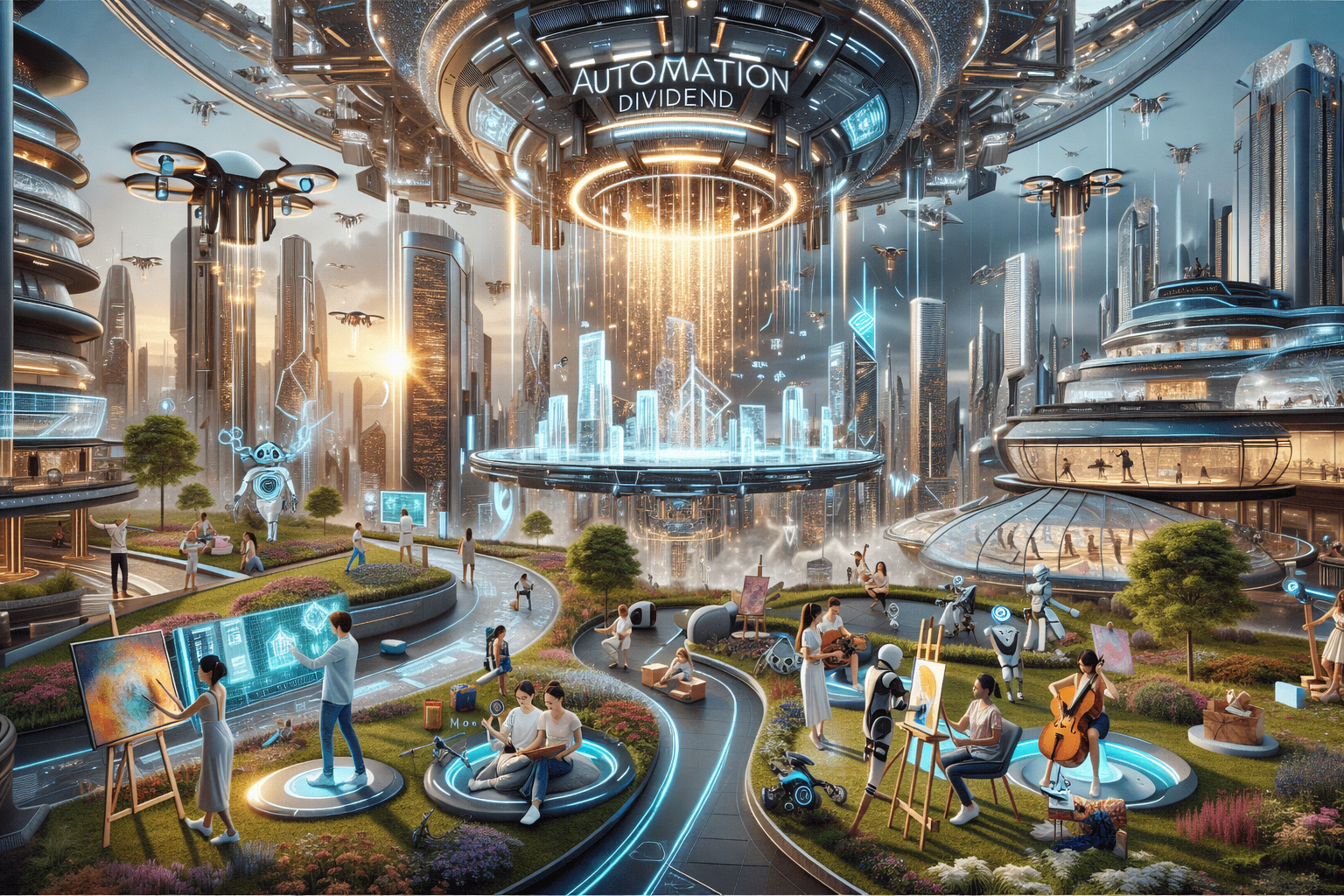
This is a crucial point, and a very dramatic one, and it must be clarified before anything else, because the real and very serious drama today is that the greatest fortune that has ever befallen humanity is seen as an impending tragedy, rather than the enormous fortune it truly is. Let me be clear: AI does not steal jobs from humans, making it impossible for them to live. AI frees humans from the need to work to live! Do you understand how huge this difference is? UBI is not alms to keep us quiet; UBI is a dividend paid to all of humanity for having reached the ability to live—and live well—without needing to work anymore, finally, after millions of years of slavery!
We must clarify this now, because the public debate is mired in embarrassing and dangerously misleading confusion.
The discussion fixates on "mass job losses," but this is a deliberate distraction. The real issue isn’t jobs disappearing—it’s wages vanishing. Demanding the "right to work" in a world where human labor is no longer needed is like insisting on the the right to ride horses on the highway. It makes no sense!
Constitutions that enshrine the "right to work" must be updated to guarantee something far more relevant: the right to share in the wealth created by automation. Until this radical shift happens in public discourse, we are hurtling toward social collapse within years.
So let’s break down why UBI isn’t just the ethical choice—it’s the only viable path forward for humanity.
The 3 Pillars of UBI: Why It’s also a Matter of Survival
Pillar 1: AI Makes Many Jobs Economically Unreasonable for Humans to Continue Doing
By 2030, up to 30% of global work hours could be automated, affecting between 400 and 800 million workers worldwide (McKinsey [1][3]). This isn’t just about replacing repetitive tasks—it’s about entire job categories becoming obsolete. For example, AI and robotics are already transforming sectors like manufacturing, logistics, and even white-collar jobs such as data analysis and customer service. In the U.S. alone, 73 million jobs (44% of the workforce) are at high risk of automation by 2030, while globally, 27% of jobs in OECD countries face the same threat.
The Paradox: More Production, Less Demand
Automation doesn’t just replace jobs—it boosts productivity and output. McKinsey estimates that AI-driven automation could add $13 trillion to the global economy by 2030, increasing productivity growth by 0.8–1.4% annually. But here’s the catch: if workers lose their jobs, who will buy all this extra output? Historical crises like the Great Depression show what happens when production outpaces demand: overproduction leads to economic collapse.
- Example: In the 1930s, factories produced more goods than people could afford, leading to mass unemployment and social unrest. Today, the same dynamic is at play: AI and robotics are creating a supply glut while wages stagnate or disappear.
The World Economic Forum predicts that AI will displace 92 million jobs by 2030 while creating 170 million new ones. But this “net gain” is deceptive:
- Skill mismatch: The new jobs—mostly in AI, green tech, or gig work—require skills that 40% of displaced workers lack, and only 25% will access adequate retraining.
- Geographic and wage gaps: New jobs cluster in tech hubs (e.g., Silicon Valley), while losses hit industrial regions. Even when workers transition, they face 20–30% pay cuts.
- Precarity: Many of the 170 million will be temporary, low-paid, or gig roles (e.g., delivery drivers, micro-tasks), without benefits like pensions or healthcare.
- Time lag: Automation happens now; reskilling takes years. Without UBI, millions will fall through the cracks, unable to afford basics even as the economy “grows.”
- Demand collapse: If wages shrink, who buys the goods produced by automated factories? History shows this leads to overproduction crises (like the 1930s)[6].
Result: A two-tier society—a small elite thriving in the AI economy, and a precarious majority struggling to survive. UBI isn’t just fair; it’s the only way to prevent economic and social collapse.
The Time Paradox: More Leisure, Less Money
Studies show that as automation reduces the need for labor, people should have more leisure time. In the U.S., leisure hours have increased over the past century, but only for those who can afford it. For the majority, losing a job means losing the ability to consume—even as the economy produces more.
- Statistic: Since 1900, leisure time in OECD countries has risen as wages and productivity grew. But today, inequality is reversing this trend: the bottom 99% are working longer hours for stagnant pay, while the top 1% enjoy both wealth and leisure.
- Risk: Without UBI, automation could create a two-tier society: a small elite with time and money, and a precarious underclass with neither.
What Happens Without UBI?
If automation proceeds without a mechanism like UBI to redistribute wealth, we face:
- Economic collapse: Overproduction + underconsumption = recession (or worse, depression).
- Social unrest: History shows that mass unemployment leads to instability (e.g., 1930s, Arab Spring).
- Wasted potential: AI could liberate humanity from drudgery, but without UBI, it will only benefit the few.
Conclusion: UBI isn’t just ethical—it’s the only way to close the loop. It ensures that the wealth created by automation is shared, turning a potential crisis into an opportunity for true human liberation.
Pillar 2: The Only Solution to the Pension System Collapse
By 2050, the worker-to-pensioner ratio will collapse across the globe:
- South Korea: From 7:1 in 2000 to 1.5:1 by 2050 (a 50-point drop, the steepest in the OECD).
- Japan: Already at 2:1 today, projected to worsen further.
- Italy: From 4:1 in 1980 to 1.3:1 by 2050 (one of the worst in the OECD).
- Spain, Greece, Poland: All face 25+ point drops in their support ratios by 2050.
- Global average: From 8:1 in 1950 to 2:1 by 2050—meaning each worker will support 3 pensioners instead of 1.
The Longevity Time Bomb
But the crisis isn’t just about ratios—it’s about how long those pensioners will live. Medical advancements are extending lifespans at an unprecedented rate:
- Global life expectancy will increase by 4.9 years for men and 4.2 years for women by 2050, even accounting for pandemics and environmental threats.
- In the OECD, women aged 65 today can expect to live to 86.6, men to 83.5—and these numbers are rising by nearly 1 year per decade.
- By 2075, life expectancy after retirement could reach 20+ years for men and 25+ for women—meaning pension systems must support retirees for decades longer than designed.
Why This Is a Mathematical Impossibility
- Pension funds are already bankrupt: The OECD estimates a $400 trillion global pension gap by 2050—five times the size of today’s global economy. In the U.S., 6 of 7 state pension funds will be insolvent by 2027.
- Aging populations + low birth rates: By 2050, 52 people aged 65+ will depend on every 100 workers (vs. 22 in 2000). In Europe, one-third of the population will be elderly.
- Pensions are being slashed: Future net replacement rates (pension vs. salary) will fall below 40% in Korea, Estonia, Ireland, and Lithuania—meaning retirees will live on less than half their working wage.
The Unthinkable Choice: The Progress We Should Give Up
But all that is only if we pretend that the world remains as it is today, which is very unlikely. Imagine instead a future where:
- Medical breakthroughs let humans live centuries.
- Human labor is no longer necessary
- There is no UBI
What happens then?
There would be no alternative, we would have to give up those immense medical breakthroughs and people would have to continue to die much sooner than would be possible simply because we have not recalibrated our societies for this kind of future. But the most likely outcome is that those medical breakthroughs would exist, but they would be the prerogative of only a few billionaires in the world. Why should a few billionaires live for centuries while the rest face poverty in old age? Because we refused to share the wealth created by technology that belongs to all of us.
The UBI Fix: Complement, Don’t Replace
- UBI doesn’t replace pensions—it prevents their collapse. By injecting liquidity into the system, it:
- Reduces pressure on pay-as-you-go schemes (e.g., Italy’s 16% of GDP spent on pensions).
- Supports informal caregivers (often unpaid family members), reducing healthcare costs.
- Allows gradual retirement age increases without pushing seniors into poverty (e.g., Sweden’s flexible "notional accounts" model).
- Without UBI, countries will face four nightmare scenarios:
- Mass elderly poverty (already happening in Greece, where pensions exceed 90% of wages—but the system is unsustainable).
- Generational war: Young workers refusing to fund pensions for a growing elderly population.
- Economic stagnation: Retirees with no spending power = collapsing domestic demand.
- Inadequacy for the future: Society incapable of absorbing and taking advantage of progress.
The Bottom Line
Pension systems were designed for a world where 10 workers supported 1 retiree who would live only a few years on average. Today, that ratio is crashing, and no reform (higher taxes, later retirement) can fix it alone. UBI is the only tool that can bridge the gap—not by replacing pensions, but by ensuring the system doesn’t implode while we transition to a new economic reality.
Pillar 3: The ‘Peacemaker’ Against Exponential Inequality
1. The Myth of "Opportunity for All"
Capitalism was sold as a system where hard work leads to prosperity. The data says otherwise:
- Wealth concentration: The top 1% of earners now capture 21% of national income in the U.S.—the same as in Mexico, and more than in South Africa (19%). In the OECD, the richest 10% own 52% of all wealth, while the bottom 60% share just 12%.
- Social mobility collapse: 80% of people in OECD countries believe inequality is too high, and they’re right. The "Great Gatsby Curve" shows that countries with higher inequality have lower social mobility—meaning if you’re born poor, you stay poor.
- Example: In the U.S., a child born in the bottom 20% has a 42% chance of staying there as an adult (vs. 30% in the 1980s).
- Global trend: Only 1 in 5 people in high-inequality countries (e.g., Brazil, India) escape the income class they’re born into.
2. Capitalism’s Structural Flaw: Monopoly by Design
The system wasn’t hacked—it’s working exactly as intended for the few:
- Profit extraction: Since 1980, the top 1%’s income grew by 158%, while the bottom 90% saw just 24%—a gap driven by automation, financialization, and weak labor rights.
- Barriers to entry:
- Education: The cost of a U.S. college degree has risen 1,200% since 1980, while wages stagnated.
- Housing: In cities like London or San Francisco, home prices grew 3x faster than incomes since 2000, locking out young families.
- Healthcare: Medical debt is the #1 cause of bankruptcy in the U.S., hitting 66% of bankruptcies.
- Corporate power: The top 0.1% of firms now control 80% of corporate profits in most sectors—monopoly levels not seen since the Gilded Age.
3. UBI: The Antitrust for People
Just as governments break up corporate monopolies to restore competition, UBI breaks the monopoly on opportunity held by the wealthy:
- Redistribution of AI dividends: If companies replace workers with AI, those profits must return to society—not just shareholders. Alaska’s oil dividend proves this works: every citizen gets a cut of resource profits since 1982, with no economic collapse.
- Floor for ambition: UBI doesn’t make people lazy—it unlocks entrepreneurship and education. Studies show that cash transfers increase small business creation by 30% and college enrollment by 20% in pilot programs (e.g., Finland, Kenya).
- Correcting capitalism’s bugs:
- Like antitrust laws, UBI doesn’t destroy the system—it prevents its self-destruction by ensuring demand (and thus markets) survive.
- Like minimum wage, it sets a baseline for dignity, but dynamically—adjusting to automation and inflation.
4. The Alternative? Collapse.
Without UBI, we’re headed for:
- Neofeudalism: A world where a few own everything, and the rest rent their lives (e.g., 60% of millennials can’t afford homes).
- Revolution or repression: History shows that extreme inequality leads to instability—whether through protests (Arab Spring, Yellow Vests) or authoritarianism (1930s fascism).
- Wasted potential: Trillions in lost innovation as talent is trapped in survival jobs instead of creating value.
Capitalism without UBI is like a rigged game of Monopoly
One player starts with all the properties, all the cash, and all the dice loaded in their favor—while the rules call it "fair competition." When the others inevitably go bankrupt, they’re told it’s their fault for not playing well enough.
UBI isn’t a handout to the losers. It’s the only way to stop the game from being rigged in the first place—by ensuring everyone gets a fair share of the board before the first roll.
Objections (And Why They’re Just Excuses)
1. ‘It’s Communism!’
This objection reveals a fundamental misunderstanding of both communism and UBI. Communism seeks to abolish private property and centralize all resources under state control. UBI, on the other hand, presupposes private property—it simply ensures that when automated systems or societal resources (like AI) generate profits, a portion of those profits is shared with the society that made them possible.
Why AI Is a Public Good—Like Medicine or Manna from Heaven
Imagine if tomorrow, manna started raining from the sky. A few private companies rush to fence it off:
"This is ours. We invested in buckets and nets to collect it first. If you want any, you’ll have to work for us."
This is exactly what’s happening with AI.
- AI isn’t just a private invention—it’s built on public data, collective knowledge, and societal infrastructure (education, legal systems, public research).
- Just like pharmaceuticals: We recognize that companies invest in R&D, so we grant them temporary patents to recoup costs. But after a set period, the invention becomes a public good (generic drugs), because society’s well-being matters more than perpetual profits.
- AI’s impact is orders of magnitude larger than any drug. If we accept that lifesaving medicines must eventually be shared, why shouldn’t the same apply to technology that replaces human labor entirely?
UBI: The "Generic" for Automation
UBI isn’t about seizing private property—it’s about acknowledging that AI, like medicine or natural resources, is a hybrid good: part private innovation, part public inheritance. When automation displaces jobs, the profits it generates must circulate back to society—not as charity, but as a dividend for the use of collective resources.
Alaska’s oil dividend proves this works: Since 1982, every citizen gets a share of oil profits. No one calls it communism—because it’s not. It’s capitalism with guardrails, ensuring that when a few profit from what belongs to all, everyone gets their fair share.
The real question isn’t "Is UBI communism?"—it’s:
"If AI is built on public knowledge, runs on public infrastructure, and reshapes our entire economy, why should its benefits belong to a tiny elite—while the costs (unemployment, instability) are dumped on everyone else?"
2. ‘It’s Not Sustainable!’
This is the most dishonest objection of all. Critics act as if UBI must start with €1,000/month for everyone—or it’s not worth doing. That’s a straw man.
The truth? UBI doesn’t need to be perfect on day one. It just needs to exist. Once the infrastructure is in place, the amounts can scale with economic conditions. The key is to start now, before the crisis makes any reform politically impossible.
The Proof: Namibia’s $13 Experiment
In 2008, a pilot in Namibia gave $13/month (about 100 Namibian dollars) to every resident in two villages. The results?
- Child malnutrition dropped by 20%.
- School dropout rates fell by 40%.
- Crime decreased by 20%.
- Local economic activity increased by 30% (because people could finally buy things).
$13 a month. Not $1,000. Not even $100. $13. And it still transformed lives.
Why Start Small?
- Political feasibility: A symbolic UBI (even $1/month) breaks the psychological barrier. Once people see it’s not the apocalypse, scaling up becomes possible.
- Crisis preparedness: When automation does displace millions of jobs, the system will already be in place to adjust the amounts dynamically—like a thermostat for economic stability.
- Psychological shift: It redefines the social contract. Instead of "You must work to deserve survival," it becomes "Society’s wealth is a shared resource."
The alternative? Waiting until the dam breaks. By then, it’ll be too late to build the levees.
Call to Action: The Fight Isn’t About Jobs—It’s About Your Share
The debate about AI "taking jobs" is a distraction. The real matter isn’t that machines will do the work—it’s that a handful of people will pocket all the wages while the rest of us are told to "adapt" or starve.
Let’s be brutally clear:
- AI doesn’t steal jobs. It just makes work unnecessary for survival.
- The problem isn’t unemployment. It’s that the wealth created by automation is being hoarded by a tiny elite, while the rest of humanity is left scrambling for crumbs.
- The solution isn’t to "save jobs." It’s to rewrite the rules so that when machines replace human labor, the profits go to all of us—not just Silicon Valley billionaires.
What We Must Demand
-
Change the Constitutions Every country that enshrines the "right to work" must update its founding documents. The right isn’t to work—it’s to share in the wealth created by technology that belongs to humanity. If AI replaces your job, you’re entitled to a dividend from the system that made it possible. This isn’t radical; it’s basic fairness.
-
Push for UBI Now
- Sign petitions to make UBI a political priority.
- Support politicians who dare to propose it—even if they’re called "communists" for doing so. (Spoiler: They’re not. They’re just not corrupt.)
- Demand pilot programs in your city or country. If Namibia can transform lives with $13/month, imagine what $100 could do.
-
Spread the Truth Share this article and ask people one question:
"When AI does your job, who should get paid: the machine’s owner, or the society that made the machine possible?" The answer is obvious. The fight starts when we refuse to accept the lie that "work" is the only way to deserve dignity.
Why This Matters Now
Every day we wait is another day the 1% consolidates control over the future. The window to act is closing fast. This isn’t about "if" AI will replace jobs—it’s about who will own the future when it does.
The choice is simple:
- Accept a world where a few own everything, and the rest rent their lives from them.
- Or demand what’s ours.
The technology is here. The wealth is here. The only thing missing is the courage to take it back.
References
1 - McKinsey: Jobs lost, jobs gained 2 - Forbes: Jobs at risk from AI 3 - DemandSage: AI job replacement stats 4 - McKinsey: AI’s $13T economic impact 5 - WEF: 92M jobs displaced by 2030 6 - Wikipedia: Overproduction crises 7 - Journal of Political Economy: Leisure and work hours 8 - CEPR: Leisure-enhancing tech 9 - Springer: Rising inequality and leisure 10 - WPR: Italy’s 1.3:1 ratio by 2050 11 - OECD: 52:100 dependency ratio by 2050 12 - YaleGlobal: Global PSR trends 13 - WEF: $400T pension gap 14 - Wikipedia: U.S. pension insolvency 15 - OECD: Net replacement rates 16 - WID: Top 1% income share 17 - OECD: Wealth inequality 18 - OECD: Social mobility 19 - Inequality Index: Mobility crisis 20 - Visual Capitalist: Global wealth Gini 21 - ScienceDirect: Cash transfers and entrepreneurship 22 - Basic Income Earth Network: Namibia pilot 23 - Global life expectancy increase by 2050 24 - OECD: Life expectancy at 65 25 - OECD: Aging populations and pension pressure 26 - OECD: Life expectancy projections 27 - OECD: Longevity and pension systems